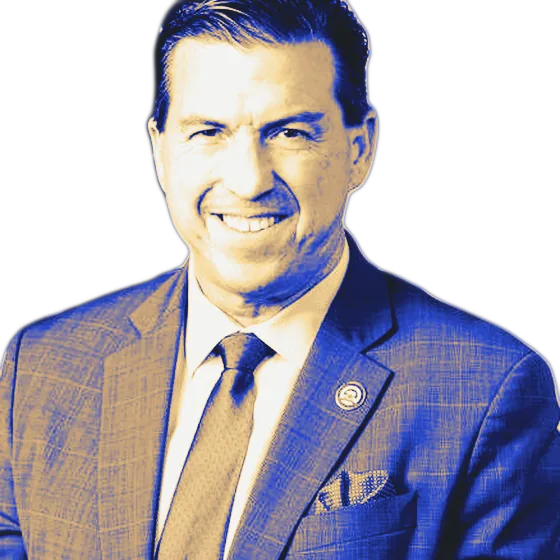
When we talk about trustworthy AI, the use of such technology in machines in the physical world pose a danger that I'd like to dig into just a little bit further. In San Francisco, which I partially represent, we have seen autonomous vehicles, or AVs, which had great promise, struggle to address some complex real-world situations. These malfunctions have obstructed public transit routes, blocked intersections, and impeded first responders from reaching people in need.
Exact quote, beginning
Kevin Mullin
u.s. representative from California on the House Science, Space, and Technology Committee
At an October 2023 House Science Committee hearing, Kevin Mullin said autonomous vehicles in San Francisco had obstructed transit routes, blocked intersections and impeded first responders, and that he is concerned there are no clear standards for the assessment of AI safety.
U.S. Representative from California and member of the House Committee on Science, Space, and Technology (Subcommittee on Investigations and Oversight; Subcommittee on Research and Technology)October 18, 2023House Science, Space, and Technology Subcommittees joint hearing, Balancing Knowledge and Governance: Foundations for Effective Risk Management of Artificial Intelligence
Context and checks
Surrounding words
The gentleman yields back. We will hear next from the gentleman from California. Mr. Mullin, you're recognized for five minutes. Mr. Mullin. Thank you, Mr. Chair. Thank you all for your attendance at this important hearing. When we talk about trustworthy AI, the use of such technology in machines in the physical world pose a danger that I'd like to dig into just a little bit further. In San Francisco, which I partially represent, we have seen autonomous vehicles, or AVs, which had great promise, struggle to address some complex real-world situations. These malfunctions have obstructed public transit routes, blocked intersections, and impeded first responders from reaching people in need. Last month, I led a letter, along with Speaker Emerita Pelosi, to the National Highway Traffic Safety Administration (NHTSA) to improve its collection of safety data so different manufacturers may be compared relative to each other and relative to manually operated vehicles. We're waiting to hear back from NHTSA on what steps it plans to take. But this is just one area where we need to be able to assess AI capabilities and its limits. And I'm concerned that we do not have clear standards for the assessment of safety. So, Ms. Tabassi, could you share more about the work NIST is doing in this area relative to safety? Ms. Tabassi. Thank you.
What this quote does not say
- The transcript preserves the spoken grammatical form 'the use ... pose a danger'; it has not been silently corrected.
- The statement concerns physical-world deployment and safety-assessment standards, not catastrophic or existential AI risk.
How this was checked
- Quote located in the captured page; spacing normalised for display.
Reviewed by
an AI reviewer that read the whole source · an automatic character-by-character check