Back to everyone

People who build AI

Jürgen Schmidhuber

AI researcher; scientific director of IDSIA; co-author of long short-term memory

3 records

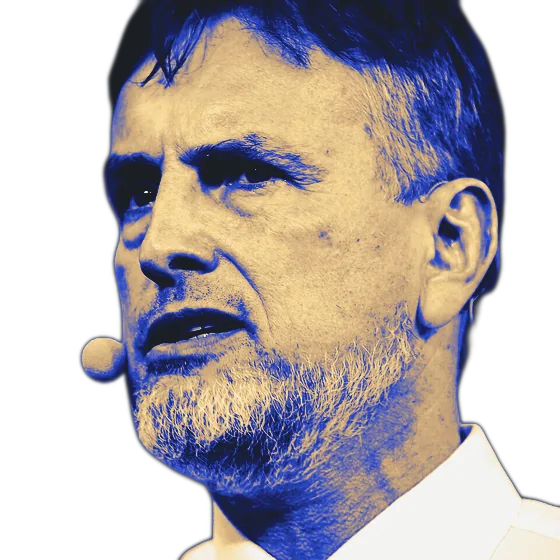
Portrait source: ITU/R.Farrell, CC BY 2.0

Records

Smart robots and/or their owners will have to pay sufficient taxes to prevent social revolutions.

Jürgen Schmidhuber

AI researcher; scientific director of IDSIA; co-author of long short-term memory

In a February 2017 interview, asked about the near-term social implications of AI, Jürgen Schmidhuber said smart robots and/or their owners will have to pay sufficient taxes to prevent social revolutions.

IDSIA – Institute Dalle Molle for Artificial IntelligencePublished February 15, 2017 · date of remarks not establishedFEDIL écho interview

Context and checks

Surrounding words

Which will be the near-term social implications of AI? Smart robots and/or their owners will have to pay sufficient taxes to prevent social revolutions. What remains to be done for humans? Freed from hard work, „Homo Ludens” (the playing man) will (as always) invent new ways of professionally interacting with other humans.

What this quote does not say

  • The target does not specify the tax base, rate, jurisdiction, or implementing authority.
  • The rest of the same answer is optimistic about employment: humans 'freed from hard work' will invent new professions, countries with many robots per capita have relatively low unemployment, and he repeats his 1980s line that new jobs are hard to predict. The tax sentence is a condition he attaches, not a prediction of mass unemployment.

How this was checked

  • Quote matched character-for-character against the captured page.

Reviewed by

an AI reviewer that read the whole source · an automatic character-by-character check

It is true that AI can be weaponized, and I have no doubt that there will be all kinds of AI arms races, but AI does not introduce a new quality of existential threat.

Jürgen Schmidhuber

AI researcher; scientific director of IDSIA; co-author of long short-term memory

In a May 2023 Forbes interview, asked whether AI poses an existential threat, Jürgen Schmidhuber said that AI can be weaponized and that there will be all kinds of AI arms races, but that AI does not introduce a new quality of existential threat.

Director of the KAUST AI Initiative; Scientific Director of the Swiss AI Lab IDSIA; co-founder and chief scientist of NNAISENSEPublished May 23, 2023 · date of remarks not establishedHessie Jones interview with Juergen Schmidhuber

Context and checks

Surrounding words

Moreover, the existential threat of this technology has been publicly acknowledged by Sam Altman, CEO of OpenAI himself, calling for AI regulation. From your perspective, is there an existential threat? Schmidhuber: It is true that AI can be weaponized, and I have no doubt that there will be all kinds of AI arms races, but AI does not introduce a new quality of existential threat. The threat coming from AI weapons seems to pale in comparison to the much older threat from nuclear hydrogen bombs that don’t need AI at all. We should be much more afraid of half-century-old tech in the form of H-bomb rockets.

What this quote does not say

  • Forbes states that the interview was edited for clarity.
  • The interview date is not supplied separately from publication.

How this was checked

  • Quote located in the captured page; spacing normalised for display.

Reviewed by

an AI reviewer that read the whole source · an automatic character-by-character check

Dasselbe LSTM kann aber auch für die Steuerung von Drohnen verwendet werden und dazu, besser Krieg zu führen.

Jürgen Schmidhuber

AI researcher; scientific director of IDSIA; co-author of long short-term memory

In a German-language August 2017 SRF interview on the dangers of AI weapons systems, Jürgen Schmidhuber said the same LSTM network that recognises speech on phones and does translation for Google and Facebook can also be used to steer drones and to wage war better.

Ko-Direktor des Schweizer Forschungsinstituts für Künstliche Intelligenz [co-director of the Swiss research institute for artificial intelligence]Published August 22, 2017 · date of remarks not establishedSRF News interview, “Experten fordern Verbot von Killerrobotern”

Context and checks

Surrounding words

Milliarden von Leuten verwenden es. Man könnte sagen, das sei doch eine gute Anwendung, und Menschen profitierten davon. Dasselbe LSTM kann aber auch für die Steuerung von Drohnen verwendet werden und dazu, besser Krieg zu führen. Und das stimmt nachdenklich. Autonome Waffen sind bereits in Gebrauch oder in der Entwicklung. Lassen sie sich überhaupt noch aufhalten?

What this quote does not say

  • The page does not say whether the text is a verbatim transcript or an edited written interview.
  • The page does not state whether the interview was conducted in German or translated into it. Schmidhuber is a native German speaker and SRF names its own interviewer ('Das Gespräch führte Beat Soltermann'), so no gap between event and publication is involved, but the language provenance is not documented on the page.

How this was checked

  • Quote matched character-for-character against the captured page.

Reviewed by

an AI reviewer that read the whole source · an automatic character-by-character check