Back to everyone

Doctors, scientists and economists

Joseph Stiglitz

Nobel laureate in economics; professor at Columbia University

4 records

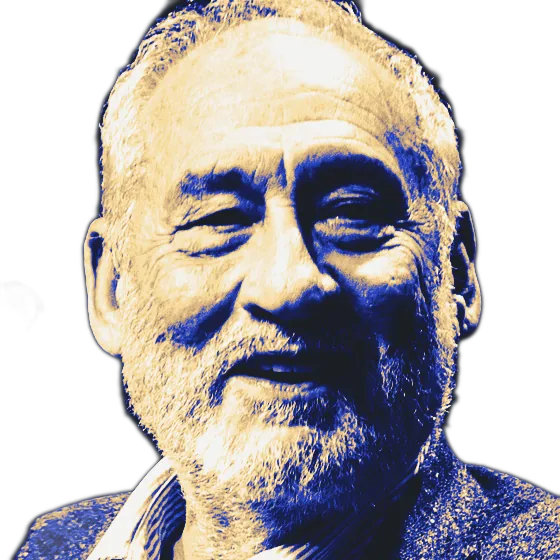
Portrait source: Jérémy Barande, CC BY-SA 2.0

Records

I'm very worried. In a way, robots have replaced routine physical work. And AI now is replacing routine white-collar work—or not replacing it but reducing the demand. So jobs that were routinely white collar, I think, will be at risk. And there are enough of those that it would have a macroeconomic effect on the level of inequality. It could amplify the sense of disillusionment.

Joseph Stiglitz

Nobel laureate in economics; professor at Columbia University

Asked in a 2023 Scientific American interview how AI-driven job-market change would affect inequality, Joseph Stiglitz said he is “very worried” that AI is reducing demand for routine white-collar work, and that there are enough such jobs “that it would have a macroeconomic effect on the level of inequality.”

Professor at Columbia University; chief economist at the Roosevelt Institute; 2001 Nobel laureate in economicsPublished August 1, 2023 · date of remarks not establishedEdited interview with Sophie Bushwick

Context and checks

Surrounding words

As someone who studies inequality extensively, how do you see these changes in the job market contributing to inequality? I'm very worried. In a way, robots have replaced routine physical work. And AI now is replacing routine white-collar work—or not replacing it but reducing the demand. So jobs that were routinely white collar, I think, will be at risk. And there are enough of those that it would have a macroeconomic effect on the level of inequality. It could amplify the sense of disillusionment. Now, that poses an advantage and a disadvantage. It may mean that large fractions of the world, of the U.S., will face this inequality.

What this quote does not say

  • The publisher labels the transcript as edited.
  • No original audio or interview date was exposed on the page, so wording was not independently audio-checked and event date remains unknown.

How this was checked

  • Quote matched character-for-character against the captured page.

Reviewed by

an AI reviewer that read the whole source · an automatic character-by-character check

We may have to use government regulation because of the weakness of the bargaining power of workers—especially in the U.S. We passed the “hours and wages bill” [the Fair Labor Standards Act of 1938] in the Great Depression, which capped the workweek at 40 hours. That was a long time ago, and now we're in a new world.

Exact quote, beginning

Joseph Stiglitz

Nobel laureate in economics; professor at Columbia University

Asked in a 2023 Scientific American interview how companies could be pushed to shorten the workweek, Joseph Stiglitz said “we may have to use government regulation because of the weakness of the bargaining power of workers” and that setting the workweek at 30 or 35 hours, with overtime beyond that, “may be the appropriate thing.”

Professor at Columbia University; chief economist at the Roosevelt Institute; 2001 Nobel laureate in economicsPublished August 1, 2023 · date of remarks not establishedEdited interview with Sophie Bushwick

Context and checks

Surrounding words

And that may be one way we accommodate this increased productivity and increased innovation. How can we incentivize companies to shorten the workweek and accept reductions in overall profitability? We may have to use government regulation because of the weakness of the bargaining power of workers—especially in the U.S. We passed the “hours and wages bill” [the Fair Labor Standards Act of 1938] in the Great Depression, which capped the workweek at 40 hours. That was a long time ago, and now we're in a new world. It may be the appropriate thing is to set it at 30 or 35 hours with a lot of flexibility, so if companies want to have the workers work more than that, then they pay them overtime. What we must recognize is that we created a system where workers don't have much bargaining power.

What this quote does not say

  • The publisher labels the transcript as edited.
  • The proposal is tentative ('may' and 'may be') rather than an unconditional legislative demand.

How this was checked

  • Quote matched character-for-character against the captured page.

Reviewed by

an AI reviewer that read the whole source · an automatic character-by-character check

It’s not going to replace teachers. It may help them do better lesson plans. It may help them tailor education better, but it’s not going to replace the teachers. We know enough about how students learn that the human interaction still seems to be very important.

Joseph Stiglitz

Nobel laureate in economics; professor at Columbia University

In a March 2026 Fortune interview, Joseph Stiglitz said AI is “not going to replace teachers” but may help them build better lesson plans and tailor education, because “the human interaction still seems to be very important.”

Nobel laureate in economicsPublished March 8, 2026 · date of remarks not establishedOriginal Fortune interview

Context and checks

Surrounding words

Take education. Stiglitz estimated it represents roughly 14% of the labor force, and he is unequivocal about what AI can and cannot do there. “It’s not going to replace teachers. It may help them do better lesson plans. It may help them tailor education better, but it’s not going to replace the teachers. We know enough about how students learn that the human interaction still seems to be very important.” Health care tells a similar story, though with a sharper political edge. The U.S.

What this quote does not say

  • The interview date and full question are not disclosed.

How this was checked

  • Quote matched character-for-character against the captured page.

Reviewed by

an AI reviewer that read the whole source · an automatic character-by-character check

Statements they signed

FROM THE SIGNED STATEMENT

It could bring risks, including large-scale job displacement, as well as opportunities such as major gains in living standards.

Signed statement:We Must Act Now” (Stanford Digital Economy Lab/economists)

Joseph Stiglitz

Nobel laureate in economics; professor at Columbia University

Signed as part of a group statement. Not spoken.

Joseph Stiglitz was listed as a signer of “We Must Act Now,” which called for guardrails and institutions to steer powerful AI toward complementing people and benefiting society.

Date not establishedWe Must Act Now

Context and checks

Surrounding words

University of Toronto Anton Korinek, University of Virginia and Anthropic Tom Cunningham, METR Michael Spence, New York University* Daron Acemoglu, MIT* Diane Coyle, University of Cambridge Chad Jones, Stanford University David Autor, MIT Joseph Stiglitz, Columbia University* Niall Ferguson, Stanford University Jason Furman, Harvard University Simon Johnson, MIT* Christopher A.

How this was checked

  • The organiser's own roster lists this person as a signer.

Reviewed by

an AI reviewer that read the whole source