Back to everyone

Military and national security

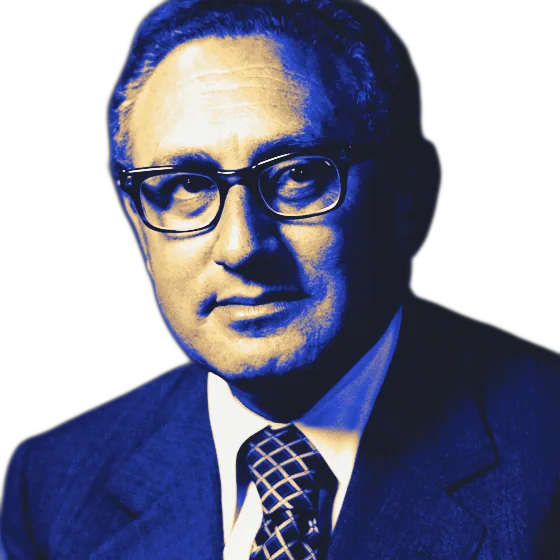
Henry Kissinger

U.S. secretary of state 1973-1977 and national security adviser 1969-1975; died 2023

3 records

Portrait source: U.S. Department of State from United States, Public domain

Records

At this point, no one can answer these questions with confidence. But as we have explored these issues for the last two years with a group of technology leaders at the forefront of the AI revolution, we have concluded that the prospects that the unconstrained advance of AI will create catastrophic consequences for the United States and the world are so compelling that leaders in governments must act now.

Henry Kissinger

U.S. secretary of state 1973-1977 and national security adviser 1969-1975; died 2023

In an October 2023 Foreign Affairs essay co-written with Graham Allison, Henry Kissinger and Allison wrote that they had concluded that the prospects that the unconstrained advance of AI will create catastrophic consequences for the United States and the world are so compelling that leaders in governments must act now.

Former U.S. Secretary of State (served 1973–1977)Published October 13, 2023 · date of remarks not establishedThe Path to AI Arms Control

Context and checks

Surrounding words

Will AI enable individuals or small groups to produce viruses capable of killing on a scale that was previously the preserve of great powers? Could AI erode the nuclear deterrents that have been a pillar of today’s world order? At this point, no one can answer these questions with confidence. But as we have explored these issues for the last two years with a group of technology leaders at the forefront of the AI revolution, we have concluded that the prospects that the unconstrained advance of AI will create catastrophic consequences for the United States and the world are so compelling that leaders in governments must act now. Even though neither they nor anyone else can know what the future holds, enough is understood to begin making hard choices and taking actions today—recognizing that these will be subject to repeated revision as more is discovered.

What this quote does not say

  • The statement is coauthored with Graham Allison, so the page establishes joint authorship rather than Kissinger's sole composition of the sentence.
  • The phrase 'catastrophic consequences' does not by itself specify extinction or a probability.

How this was checked

  • Quote matched character-for-character against the captured page.

Reviewed by

an AI reviewer that read the whole source · an automatic character-by-character check

We confront a choice—between the comfort of the historically independent human and the possibilities of an entirely new partnership between human and machine. That choice is difficult. Instilling a bracing sense of apprehension about the rise of AI is essential. But, properly designed, AI has the potential to save the planet, and our species, and to elevate human flourishing. This is why progressing, with all due caution, toward the age of Homo technicus is the right choice.

Exact quote, beginning

Henry Kissinger

U.S. secretary of state 1973-1977 and national security adviser 1969-1975; died 2023

In an excerpt from Genesis, a book Henry Kissinger co-wrote with Eric Schmidt and Craig Mundie that The Atlantic published in November 2024, after Kissinger's death, the authors wrote that instilling a bracing sense of apprehension about the rise of AI is essential but that, properly designed, AI has the potential to save the planet and our species, and that they see this moment with sober optimism as a new beginning rather than humanity's final act.

Former U.S. Secretary of State (served 1973–1977)Published November 12, 2024 · date of remarks not establishedAI Can Save Humanity—Or End It

Context and checks

Surrounding words

In contrast, the integration of human assumptions into the internal workings of AIs—including AIs that are programmed to govern other AIs—seems to us more reliable. We confront a choice—between the comfort of the historically independent human and the possibilities of an entirely new partnership between human and machine. That choice is difficult. Instilling a bracing sense of apprehension about the rise of AI is essential. But, properly designed, AI has the potential to save the planet, and our species, and to elevate human flourishing. This is why progressing, with all due caution, toward the age of Homo technicus is the right choice. Some may view this moment as humanity’s final act. We see it, with sober optimism, as a new beginning. The article was adapted from the forthcoming book Genesis: Artificial Intelligence, Hope, and the Human Spirit. One of the authors, Henry Kissinger, died before publication.

What this quote does not say

  • Kissinger died before publication, and the source does not disclose when he drafted or reviewed this passage.
  • This qualifies the overall framing but does not retract the October 2023 catastrophic-risk statement.

How this was checked

  • Quote matched character-for-character against the captured page.

Reviewed by

an AI reviewer that read the whole source · an automatic character-by-character check

Biden and Xi should thus meet in the near future for a private conversation about AI arms control. November’s Asia-Pacific Economic Cooperation meeting in San Francisco offers that opportunity. Each leader should discuss how he personally assesses the risks posed by AI, what his country is doing to prevent applications that pose catastrophic risks, and how his country is ensuring that domestic companies are not exporting risks.

Henry Kissinger

U.S. secretary of state 1973-1977 and national security adviser 1969-1975; died 2023

In the same October 2023 Foreign Affairs essay, Henry Kissinger and Graham Allison wrote that President Biden and President Xi should meet in the near future for a private conversation about AI arms control, naming that November's Asia-Pacific Economic Cooperation meeting in San Francisco as the opportunity.

Former U.S. Secretary of State (served 1973–1977)Published October 13, 2023 · date of remarks not establishedThe Path to AI Arms Control

Context and checks

Surrounding words

While China still lags in the technology to make advanced semiconductors, it possesses the essentials to power ahead in the immediate future. Biden and Xi should thus meet in the near future for a private conversation about AI arms control. November’s Asia-Pacific Economic Cooperation meeting in San Francisco offers that opportunity. Each leader should discuss how he personally assesses the risks posed by AI, what his country is doing to prevent applications that pose catastrophic risks, and how his country is ensuring that domestic companies are not exporting risks. To inform the next round of their discussions, they should create an advisory group consisting of U.S. and Chinese AI scientists and others who have reflected on the implications of these developments.

What this quote does not say

  • The recommendation is coauthored with Graham Allison, so the page establishes joint authorship rather than Kissinger's sole composition of the passage.
  • The proposed November 2023 opportunity is historical and should not be presented as a current recommendation.

How this was checked

  • Quote matched character-for-character against the captured page.

Reviewed by

an AI reviewer that read the whole source · an automatic character-by-character check