Back to everyone

Doctors, scientists and economists

Erik Brynjolfsson

Stanford professor and director of its Digital Economy Lab; economist of automation

5 records

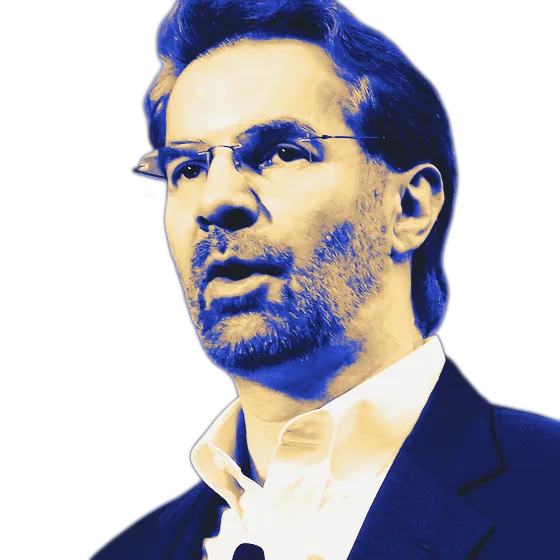
Portrait source: Gordon Haff, CC BY-SA 2.0

Records

As more tasks are automated, a fully automated economy could, in principle, be structured to redistribute the benefits from production widely, even to those people who are no longer strictly necessary for value creation. However, the beneficiaries would be in a weak bargaining position to prevent a change in the distribution that left them with little or nothing. Their incomes would depend on the decisions of those in control of the technology.

Exact quote, beginning

Erik Brynjolfsson

Stanford professor and director of its Digital Economy Lab; economist of automation

In a 2022 Dædalus essay, Brynjolfsson wrote that in a fully automated economy the people no longer strictly necessary for value creation would be in a weak bargaining position, that their incomes would depend on the decisions of those in control of the technology, and that this opens the door to increased concentration of wealth and power.

Jerry Yang and Akiko Yamazaki Professor and Senior Fellow at the Institute for Human-Centered AI and Director of the Digital Economy Lab at Stanford UniversityPublished April 13, 2022 · date of remarks not establishedDædalus, Volume 151, Issue 2

Context and checks

Surrounding words

Automation increases productivity. Moreover, there are many tasks that are dangerous, dull, or dirty, and those are often the first to be automated. As more tasks are automated, a fully automated economy could, in principle, be structured to redistribute the benefits from production widely, even to those people who are no longer strictly necessary for value creation. However, the beneficiaries would be in a weak bargaining position to prevent a change in the distribution that left them with little or nothing. Their incomes would depend on the decisions of those in control of the technology. This opens the door to increased concentration of wealth and power. This highlights the promise and the peril of achieving HLAI: building machines designed to pass the Turing Test and other, more sophisticated metrics of human-like intelligence.7 On the one hand, it is a path to unprecedented wealth,

What this quote does not say

  • The passage is a conditional economic scenario about a fully automated economy, not a forecast that full automation or that distribution will occur.
  • The essay's own remedy is explicitly not to slow AI down: 'The solution is not to slow down technology, but rather to eliminate or reverse the excess incentives for automation over augmentation.' The concentration risk is contingent on automation being chosen over augmentation, which the essay treats as a policy and design choice.

How this was checked

  • Quote matched character-for-character against the captured page.

Reviewed by

an AI reviewer that read the whole source · an automatic character-by-character check

As the share of GDP that goes to labor continues to fall, we must create a more level playing field, particularly as AI starts to affect more and more of the labor force. This means taxing capital and labor at comparable rates, encouraging investments in human capital just as we do for physical capital, and updating corporate governance to recognized workers as stakeholders alongside stockholders.

Exact quote, beginning

Erik Brynjolfsson

Stanford professor and director of its Digital Economy Lab; economist of automation

In September 2019 testimony to a House science subcommittee, Brynjolfsson recommended taxing capital and labor at comparable rates, encouraging investment in human capital as in physical capital, updating corporate governance to recognize workers as stakeholders alongside stockholders, and expanding the earned income tax credit, as AI affects more and more of the labor force.

Schussel Family Professor of Management Science and Director, The MIT Initiative on the Digital Economy, Massachusetts Institute of TechnologySeptember 24, 2019House Subcommittee on Research and Technology hearing, Artificial Intelligence and the Future of Work

Context and checks

Surrounding words

Page 4 expense of labor. As the share of GDP that goes to labor continues to fall, we must create a more level playing field, particularly as AI starts to affect more and more of the labor force. This means taxing capital and labor at comparable rates, encouraging investments in human capital just as we do for physical capital, and updating corporate governance to recognized workers as stakeholders alongside stockholders. We can also expand the earned income tax credit to boost incomes for the working poor and use revenues from carbon taxes and other Pigouvian taxes to lower taxes on work and create a carbon dividend.. 3. Invest in US technology leadership The US has long been a leader not just in AI, but in a broad swath of technologies.

What this quote does not say

  • This is the second of five policy recommendations in a written statement; the passage is his own recommendation, and the testimony states 'These are my own views. I am not speaking for anyone else.'
  • The official statement reads 'recognized workers as stakeholders'; the apparent grammatical error is preserved rather than silently corrected.

How this was checked

  • Quote located in the captured page; spacing normalised for display.

Reviewed by

an AI reviewer that read the whole source · an automatic character-by-character check

Statements they signed

FROM THE SIGNED STATEMENT

Mitigating the risk of extinction from AI should be a global priority alongside other societal-scale risks such as pandemics and nuclear war.

Signed statement:Statement on AI Extinction Risk” (CAIS)

Erik Brynjolfsson

Stanford professor and director of its Digital Economy Lab; economist of automation

Signed as part of a group statement. Not spoken.

Erik Brynjolfsson signed the “Statement on AI Extinction Risk,” which says reducing the risk of extinction from AI should be a global priority alongside pandemics and nuclear war.

Professor and Senior Fellow, Stanford Institute for Human-Centered AIDate not establishedStatement on AI Extinction Risk

Context and checks

Surrounding words

Stanford University AI Scientists Joseph Sifakis Turing Award 2007, Professor, CNRS - Universite Grenoble - Alpes Other Notable Figures Atoosa Kasirzadeh Assistant Professor, University of Edinburgh, Alan Turing Institute AI Scientists Erik Brynjolfsson Professor and Senior Fellow, Stanford Institute for Human-Centered AI Other Notable Figures Mustafa Suleyman CEO, Inflection AI Other Notable Figures Emad Mostaque CEO, Stability AI Other Notable Figures Ian Goodfellow Principal

How this was checked

  • The organiser's own roster lists this person as a signer.

Reviewed by

an AI reviewer that read the whole source

FROM THE SIGNED STATEMENT

It could bring risks, including large-scale job displacement, as well as opportunities such as major gains in living standards.

Signed statement:We Must Act Now” (Stanford Digital Economy Lab/economists)

Erik Brynjolfsson

Stanford professor and director of its Digital Economy Lab; economist of automation

Signed as part of a group statement. Not spoken.

Erik Brynjolfsson was listed as a signer of “We Must Act Now,” a statement calling on economists, policymakers, and technology leaders to build incentives, guardrails, and institutions that steer AI toward complementing people and benefiting society.

Stanford UniversityDate not establishedWe Must Act Now

Context and checks

Surrounding words

and technology leaders must act now to understand the economics of transformative AI and to build the incentives, guardrails, and institutions needed to steer AI in a direction that complements humans and benefits society. ⬇ Signatories Erik Brynjolfsson, Stanford University Ajay Agrawal, University of Toronto Anton Korinek, University of Virginia and Anthropic Tom Cunningham, METR Michael Spence, New York University* Daron Acemoglu, MIT* Diane Coyle, University of Cambridge Chad Jones,

How this was checked

  • The organiser's own roster lists this person as a signer.

Reviewed by

an AI reviewer that read the whole source

FROM THE SIGNED STATEMENT

We recommend expanded research aimed at ensuring that increasingly capable AI systems are robust and beneficial: our AI systems must do what we want them to do.

Signed statement:Research Priorities for Robust and Beneficial AI” (FLI)

Erik Brynjolfsson

Stanford professor and director of its Digital Economy Lab; economist of automation

Signed as part of a group statement. Not spoken.

Erik Brynjolfsson signed “Research Priorities for Robust and Beneficial AI,” an open letter calling for expanded research to ensure increasingly capable AI systems are robust, beneficial, and do what people want them to do.

MIT, Professor at and director of MIT Initiative on the Digital EconomyDate not establishedResearch Priorities for Robust and Beneficial AI

Context and checks

Surrounding words

Stanford, AI Ph.D. student Nick Hay, Berkeley, AI Ph.D. student Jaan Tallinn, co-founder of Skype, CSER and FLI Elon Musk, SpaceX, Tesla Motors Steve Wozniak, co-founder of Apple Luke Nosek, Founders Fund Aaron VanDevender, Founders Fund Erik Brynjolfsson, MIT, Professor at and director of MIT Initiative on the Digital Economy Margaret Boden, U.

How this was checked

  • The organiser's own roster lists this person as a signer.

Reviewed by

an AI reviewer that read the whole source