Back to everyone

Business leaders

Eric Schmidt

former CEO and chairman of Google; coauthor of Superintelligence Strategy

3 records

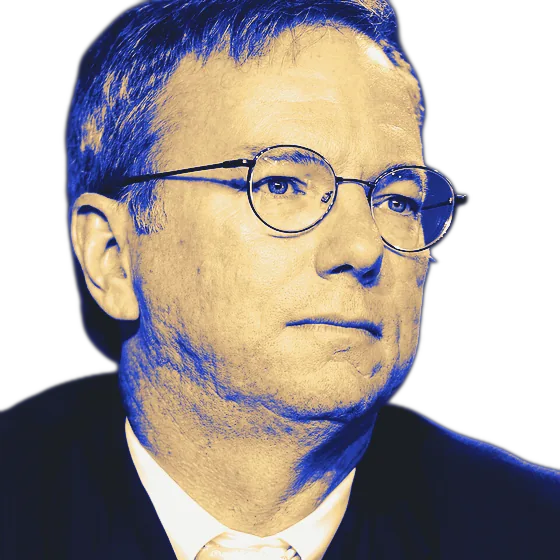
Portrait source: Guillaume Paumier, CC BY 3.0

Records

Even with our best existing technical safeguards in place, if people initiate a full-throttle intelligence recursion, losing control is highly likely and the default.

Eric Schmidt

former CEO and chairman of Google; coauthor of Superintelligence Strategy

In the April 2025 paper 'Superintelligence Strategy: Expert Version,' Schmidt and coauthors Dan Hendrycks and Alexandr Wang wrote that even with the best existing technical safeguards in place, if people initiate a full-throttle intelligence recursion, losing control is highly likely and the default.

Chair, Special Competitive Studies Project; former CEO and Chairman of GooglePublished April 14, 2025 · date of remarks not establishedSuperintelligence Strategy: Expert Version

Context and checks

Surrounding words

Moreover, we cannot run repeated large-scale tests of later stages of the recursion without risking disaster, so it is less amenable to the empirical iterative tinkering we usually rely on. Even with our best existing technical safeguards in place, if people initiate a full-throttle intelligence recursion, losing control is highly likely and the default. Intelligence Recursion as a Path to Strategic Monopoly. Despite the danger, intelligence recursion remains a powerful lure for states seeking to overtake their rivals.

What this quote does not say

  • The claim is conditional on people initiating a full-throttle intelligence recursion — fully autonomous AI research and development, which the paper distinguishes from today's AI-assisted R&D. It is not a probability estimate for current AI or for all paths to advanced AI.
  • 'Highly likely' is given no numerical value. Elsewhere the same chapter discusses officials tolerating 'a double-digit risk of losing control', but that is a description of others' risk tolerance, not a probability the authors assign to this sentence.

How this was checked

  • Quote matched character-for-character against the captured page.

Reviewed by

an AI reviewer that read the whole source · an automatic character-by-character check

First and foremost, AI systems must remain under direct human control—they should not be autonomous entities independent from human operators.

Eric Schmidt

former CEO and chairman of Google; coauthor of Superintelligence Strategy

In the April 2025 paper 'Superintelligence Strategy: Expert Version,' Schmidt and coauthors Dan Hendrycks and Alexandr Wang wrote that AI systems must remain under direct human control and should not be autonomous entities independent from human operators.

Chair, Special Competitive Studies Project; former CEO and Chairman of GooglePublished April 14, 2025 · date of remarks not establishedSuperintelligence Strategy: Expert Version

Context and checks

Surrounding words

If carefully maintained, MAIM can both discourage destabilizing AI projects while also preventing escalation. - 7. How do we prevent an erosion of control? First and foremost, AI systems must remain under direct human control—they should not be autonomous entities independent from human operators. This establishes a clear line that AI systems are tools controlled by humans, not independent actors. This control needs to be made meaningful through clear fiduciary obligations.

What this quote does not say

  • The sentence opens the paper's FAQ answer to 'How do we prevent an erosion of control?', not a chapter of the main argument.
  • It states a principle with no enforcement mechanism and no capability threshold; the answer grounds the control in fiduciary obligations, forecasting support, and informed consent.

How this was checked

  • Quote matched character-for-character against the captured page.

Reviewed by

an AI reviewer that read the whole source · an automatic character-by-character check

Statements they signed

FROM THE SIGNED STATEMENT

It could bring risks, including large-scale job displacement, as well as opportunities such as major gains in living standards.

Signed statement:We Must Act Now” (Stanford Digital Economy Lab/economists)

Eric Schmidt

former CEO and chairman of Google; coauthor of Superintelligence Strategy

Signed as part of a group statement. Not spoken.

Eric Schmidt was listed as a signer of “We Must Act Now,” a statement calling on economists, policymakers, and technology leaders to build incentives, guardrails, and institutions that steer AI toward complementing people and benefiting society.

Former CEO of GoogleDate not establishedWe Must Act Now

Context and checks

Surrounding words

Pissarides, London School of Economics* Paul Milgrom, Stanford University* George Akerlof, Georgetown University and University of California, Berkeley* Philippe Aghion, INSEAD* Dan Hendrycks, Center for AI Safety Eric Schmidt, Former CEO of Google Peter Howitt, Brown University* Oliver D. Hart, Harvard University* Bengt Holmstrom, MIT* Alvin Roth, Stanford University* Michael Kremer, University of Chicago* Roger B.

How this was checked

  • The organiser's own roster lists this person as a signer.

Reviewed by

an AI reviewer that read the whole source