Back to everyone

People who build AI

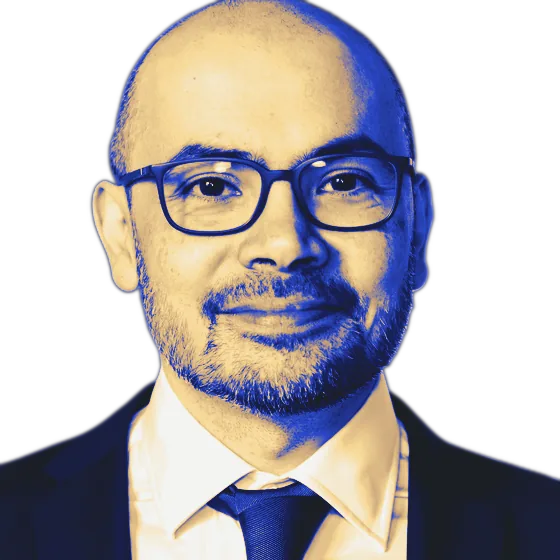
Demis Hassabis

CEO of Google DeepMind and Nobel laureate

5 records

Portrait source: John Sears, CC BY-SA 4.0

Records

AI is already starting to deliver real-world benefits but to realise its immense promise, we have to navigate this critical period of development thoughtfully and carefully. Urgent action is needed to address risks that might arise as we get closer to AGI. We’ve already seen the challenges frontier models pose for cybersecurity, and other threats including nuclear and bio risks may soon emerge as capabilities continue to advance.

Exact quote, beginning

Demis Hassabis

CEO of Google DeepMind and Nobel laureate

In a July 2026 essay on his Substack, Demis Hassabis wrote that urgent action is needed on risks arising as AGI gets closer, citing the cybersecurity challenges frontier models already pose, nuclear and bio threats that may soon emerge, and the need for robust safeguards to maintain control of increasingly agentic, recursively self-improving systems.

Co-Founder and CEO, Google DeepMind and Isomorphic LabsPublished July 14, 2026 · date of remarks not establishedA Framework for Frontier AI and the Dawning of a New Age

Context and checks

Surrounding words

We could even reach a point where resources are no longer the limiting factor for human progress, leading to an amazing new era of abundance. The Challenges of the Frontier AI is already starting to deliver real-world benefits but to realise its immense promise, we have to navigate this critical period of development thoughtfully and carefully. Urgent action is needed to address risks that might arise as we get closer to AGI. We’ve already seen the challenges frontier models pose for cybersecurity, and other threats including nuclear and bio risks may soon emerge as capabilities continue to advance. On the horizon, we will need robust safeguards to maintain control of increasingly agentic, recursively self-improving systems - and tackle unknown issues that will only become clearer over time. I’ve always believed in the power of human ingenuity and creativity to solve any problem.

What this quote does not say

  • The passage does not estimate the probability or severity of any named outcome.
  • The next paragraph of the same essay qualifies the passage: he writes that he is 'confident that mitigating the technical risks related to AI is a challenge we can collectively address', and the essay's stated posture is 'cautious optimism'.

How this was checked

  • Quote located in the captured page; spacing normalised for display.

Reviewed by

an AI reviewer that read the whole source · an automatic character-by-character check

My feeling on that is the risks are unknown. So there's a lot of people, my colleagues, famous Turing Award winners on both sides of that argument. I think the right answer is somewhere in the middle, which is, if you look at that debate, there's very smart people on both sides of that debate. So what that tells me is that we don't know enough about it yet to actually quantify the risk.

Exact quote, beginning

Demis Hassabis

CEO of Google DeepMind and Nobel laureate

Asked in a 2025 TIME interview whether AI systems seeking power, deceiving, or escaping human control is the default path or a tail risk, Demis Hassabis said the risks are unknown and not yet quantifiable, that control may turn out to be easier than the most pessimistic expected, and that there is still significant risk.

CEO of Google DeepMindPublished April 27, 2025 · date of remarks not establishedGoogle DeepMind CEO Demis Hassabis on AI in the Military and What AGI Could Mean for Humanity

Context and checks

Surrounding words

Do you have a strong view on whether that's the default path, or is that a tail risk? My feeling on that is the risks are unknown. So there's a lot of people, my colleagues, famous Turing Award winners on both sides of that argument. I think the right answer is somewhere in the middle, which is, if you look at that debate, there's very smart people on both sides of that debate. So what that tells me is that we don't know enough about it yet to actually quantify the risk. It might turn out that as we develop these systems further, it's way easier to keep control of these systems than we thought, or we expected, hypothetically. Quite a lot of things have turned out like that. So there's some evidence towards the fact that that things may be a little bit easier than some of the most pessimist were thinking, but in my view, there's still significant risk, and we've got to do research carefully to quantify what that risk is, and then deal with it ahead of time with as much foresight as possible, rather than after the fact, which, with technologies this powerful and this transformative, could be extremely risky. hat keeps you up at night? For me, it's this question of international standards and cooperation, not just between countries, but also between companies and researchers as we get towards the final steps of AGI.

What this quote does not say

  • TIME states that the interview was condensed and edited for clarity.
  • The interview date is not supplied, so only the publication date is recorded.

How this was checked

  • Quote located in the captured page; spacing normalised for display.

Reviewed by

an AI reviewer that read the whole source · an automatic character-by-character check

Statements they signed

FROM THE SIGNED STATEMENT

Mitigating the risk of extinction from AI should be a global priority alongside other societal-scale risks such as pandemics and nuclear war.

Signed statement:Statement on AI Extinction Risk” (CAIS)

Demis Hassabis

CEO of Google DeepMind and Nobel laureate

Signed as part of a group statement. Not spoken.

Demis Hassabis signed the Statement on AI Extinction Risk, which says reducing the risk of extinction from AI should be a global priority alongside pandemics and nuclear war.

CEO, Google DeepMindDate not establishedStatement on AI Extinction Risk

Context and checks

Surrounding words

Oops! Something went wrong while submitting the form. Geoffrey Hinton Emeritus Professor of Computer Science, University of Toronto AI Scientists Yoshua Bengio Professor of Computer Science, U. Montreal / Mila AI Scientists Demis Hassabis CEO, Google DeepMind AI Scientists Sam Altman CEO, OpenAI Other Notable Figures Dario Amodei CEO, Anthropic AI Scientists Dawn Song Professor of Computer Science, UC Berkeley AI Scientists Ted Lieu Congressman, US House of Representatives

What this quote does not say

  • The roster's wording for Hassabis's role is “CEO, Google DeepMind.”

How this was checked

  • The organiser's own roster lists this person as a signer.

Reviewed by

an AI reviewer that read the whole source

FROM THE SIGNED STATEMENT

These can be weapons of terror, weapons that despots and terrorists use against innocent populations, and weapons hacked to behave in undesirable ways.

Signed statement:2017 Open Letter to the UN CCW” (Toby Walsh/FLI)

Demis Hassabis

CEO of Google DeepMind and Nobel laureate

Signed as part of a group statement. Not spoken.

Demis Hassabis signed the 2017 Open Letter to the UN CCW, which urges governments to prevent an arms race in lethal autonomous weapons and protect civilians from their misuse.

CEODate not established2017 Open Letter to the UN CCW

Context and checks

Surrounding words

Daniel Hulme, founder & CEO of Satalia, UK. Bradley Kieser, founder & Director of SMS Speedway, UK. Charlie Muirhead & Tabitha Goldstaub, founders & CEO of CognitionX, UK. Geoff Pegman, founder & MD of R U Robots, UK. Demis Hassabis & Mustafa Suleyman, founders, CEO & Head of Applied AI, DeepMind, UK. Donald Szeto, Thomas Stone & Kenneth Chan, founders, CTO, COO & Head of Engineering of PredictionIO, UK. Antoine Biondeau, founder & CEO of Sentient Technologies, USA.

How this was checked

  • The organiser's own roster lists this person as a signer.

Reviewed by

an AI reviewer that read the whole source

FROM THE SIGNED STATEMENT

We recommend expanded research aimed at ensuring that increasingly capable AI systems are robust and beneficial: our AI systems must do what we want them to do.

Signed statement:Research Priorities for Robust and Beneficial AI” (FLI)

Demis Hassabis

CEO of Google DeepMind and Nobel laureate

Signed as part of a group statement. Not spoken.

Demis Hassabis was listed as a signer of Research Priorities for Robust and Beneficial AI, which calls for more research to ensure increasingly capable AI systems are robust and beneficial.

co-founder of DeepMindDate not establishedResearch Priorities for Robust and Beneficial AI

Context and checks

Surrounding words

of Computer Science, co-chair of the AAAI presidential panel on long-term AI futures Francesca Rossi, Padova & Harvard, Professor of Computer Science, IJCAI President and Co-chair of AAAI committee on impact of AI and Ethical Issues Demis Hassabis, co-founder of DeepMind Shane Legg, co-founder of DeepMind Mustafa Suleyman, co-founder of DeepMind Dileep George, co-founder of Vicarious Scott Phoenix, co-founder of Vicarious Yann LeCun, head of Facebook’s Artificial Intelligence

What this quote does not say

  • The roster's wording for Hassabis's role is “co-founder of DeepMind.”

How this was checked

  • The organiser's own roster lists this person as a signer.

Reviewed by

an AI reviewer that read the whole source