Back to everyone

Faith leaders

Bartholomew I

ecumenical patriarch of Constantinople

3 records

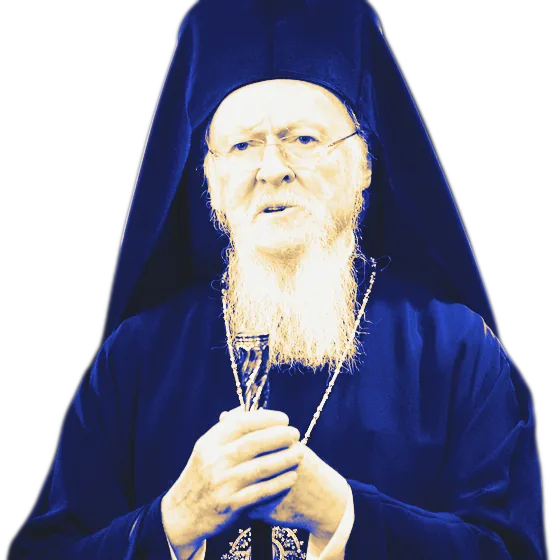
Portrait source: Υπουργείο Εξωτερικών, CC BY-SA 2.0

Records

The deeper challenge of artificial intelligence, however, concerns the very image of man. The reductionist view that regards man as a complex biochemical computer finds in artificial intelligence its final justification. If thought is simply data processing, then the machine can indeed surpass its creator.

Exact quote, beginning

Bartholomew I

ecumenical patriarch of Constantinople

In a July 2025 keynote address in Istanbul, Bartholomew I said that artificial intelligence puts humanity in danger of losing not only the control of its tools but the very sense of what it means to be human.

Archbishop of Constantinople-New Rome and Ecumenical PatriarchJuly 29, 2025Meeting of the World Council of Religions for Peace, Istanbul

Context and checks

Surrounding words

Human judgement, with its nuances, its intuition and its compassion, is in danger of being replaced by the cold efficiency of the machine. The deeper challenge of artificial intelligence, however, concerns the very image of man. The reductionist view that regards man as a complex biochemical computer finds in artificial intelligence its final justification. If thought is simply data processing, then the machine can indeed surpass its creator. In this perspective, the unique, unrepeatable and infinitely valuable person, that which Christian theology perceives as the “in the image,” shrinks into a set of data, into a predictable pattern of behaviour. Freedom, creativity, love, prayer, all these expressions of human uniqueness, are stripped of their mystery and are analysed as neural processes. Humanity is in danger of losing not only the control of its tools, but the very sense of what it means to be human. Both global debt and artificial intelligence, despite their different appearance, spring from the same philosophical root: the apotheosis of abstraction and of utility.

What this quote does not say

  • The warning is qualitative: no probability, time horizon, or technical mechanism of loss of control is given.
  • 'Losing the control of its tools' sits inside a theological argument about the image of man; it includes moral and conceptual control and should not be read as the technical AI-safety sense alone.

How this was checked

  • Quote matched character-for-character against the captured page.

Reviewed by

an AI reviewer that read the whole source · an automatic character-by-character check

Consequently, the demand for the establishment of a robust regulatory framework for Artificial Intelligence is not an act of technophobia or of anachronistic conservatism. On the contrary, it is an act of the highest responsibility and of foresight. We do not seek to limit the development of this new and much-promising technology, but to frame it, to orient it, to integrate it within a humanistic and spiritual horizon.

Exact quote, beginning

Bartholomew I

ecumenical patriarch of Constantinople

In a September 2025 public lecture at the University of Latvia in Riga, Bartholomew I said that demanding a robust regulatory framework for artificial intelligence is an act of responsibility rather than technophobia, and that such a framework cannot be the product of technocrats and entrepreneurs alone but must also involve theologians, philosophers, sociologists, lawyers and artists.

Archbishop of Constantinople-New Rome and Ecumenical PatriarchSeptember 12, 2025Public lecture at the University of Latvia, Riga

Context and checks

Surrounding words

But this knowledge by itself is not enough to check the momentum towards an even greater technological performance, if it is not accompanied by a deep moral awakening. Consequently, the demand for the establishment of a robust regulatory framework for Artificial Intelligence is not an act of technophobia or of anachronistic conservatism. On the contrary, it is an act of the highest responsibility and of foresight. We do not seek to limit the development of this new and much-promising technology, but to frame it, to orient it, to integrate it within a humanistic and spiritual horizon. Such a framework cannot be a product only of technocrats and of entrepreneurs. It must be the result of a broad and polyphonic conversation, where theologians, philosophers, sociologists, lawyers, artists shall participate. We must ensure that Artificial Intelligence will be placed in the service of man and of creation, and not in the service of impersonal mechanisms of profit which are indifferent to the environmental and social cost. The Ecumenical Patriarchate, from its See in the Phanar, has for a long time been proclaiming the need of bridging the gap between faith and science, ethics and technology.

What this quote does not say

  • The address names no jurisdiction, regulator, legal instrument, enforcement mechanism, or technical threshold; the position is a direction, not a legislative proposal.
  • The framing is theological and humanistic; 'robust regulatory framework' is Bartholomew's own phrase and is not defined further in the lecture.

How this was checked

  • Quote matched character-for-character against the captured page.

Reviewed by

an AI reviewer that read the whole source · an automatic character-by-character check

Artificial intelligence in particular is a significant, promising, and multidimensional development; yet it must not become a factor in the marginalization of the human person, as many fear. We are confident that all the relevant institutions will cooperate in ensuring the ethical and legal framework for the development and application of artificial intelligence.

Bartholomew I

ecumenical patriarch of Constantinople

In a June 2026 address to visiting journalists, Bartholomew I said artificial intelligence is a significant, promising and multidimensional development that must not become a factor in the marginalization of the human person.

Archbishop of Constantinople-New Rome and Ecumenical PatriarchJune 20, 2026Message to journalists at the Ecumenical Patriarchate

Context and checks

Surrounding words

In this constantly changing environment, we are called to make rational and prudent use of technological achievements, such as artificial intelligence, so that humanity as a whole may benefit. Artificial intelligence in particular is a significant, promising, and multidimensional development; yet it must not become a factor in the marginalization of the human person, as many fear. We are confident that all the relevant institutions will cooperate in ensuring the ethical and legal framework for the development and application of artificial intelligence. With regard to the journalistic vocation, we hope that your role will not be replaced by texts — perhaps technically flawless, but certainly without soul — or by visual and audio reports generated by digital programmes.

What this quote does not say

  • This is a balancing statement in emphasis, not a retraction or contradiction of his 2025 warnings.
  • 'Marginalization of the human person' is broader than job displacement; the labor reading rests on the immediately following sentence, in which he hopes journalists' role will not be replaced by AI-generated texts and reports.

How this was checked

  • Quote matched character-for-character against the captured page.

Reviewed by

an AI reviewer that read the whole source · an automatic character-by-character check